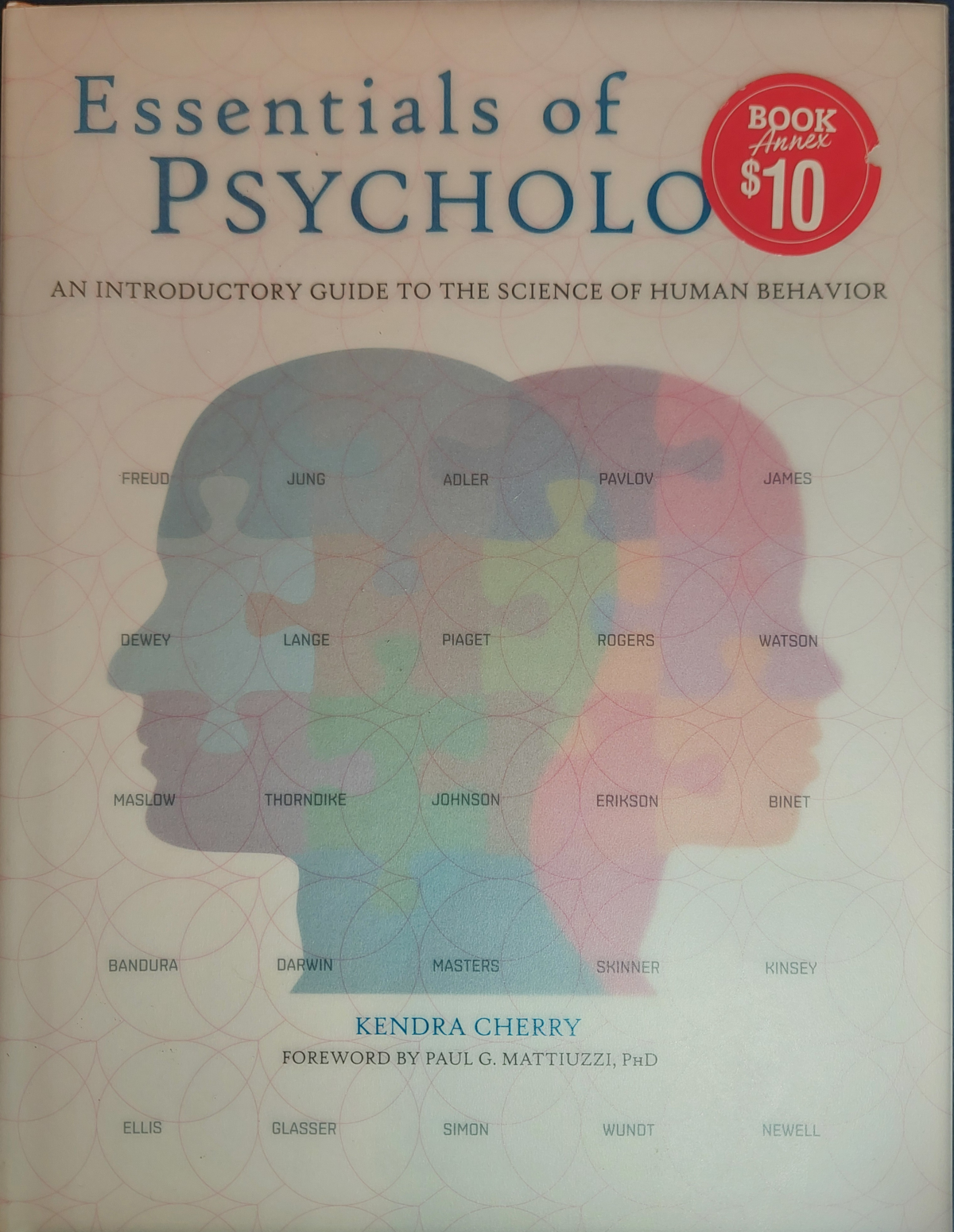
I read through this in the first half of January and thought I’d share some thoughts. It’s a relatively easy read, and I think I would recommend it, with a few quibbles.
My single biggest quibble is the almost obnoxious lack of illustrations and diagrams, even in areas that would be so much better if they had it. For example, chapter 4 discusses the anatomy of the brain, including specific parts like the thalamus.
Despite that, there’s not a single diagram of the brain to be found. The reader is merely left to imagine these structures in the abstract, perhaps wondering where in the brain they might be located. I would strongly suggest reading parts like this with a browser handy to consult diagrams elsewhere, such as on Wikipedia.
With that gripe out of the way, I thought I’d go through and highlight some of the chapters that I feel contained the most valuable material. At the very least, these are the ones that left the biggest impressions on me.
Chapter 7, on Conditioning, is fascinating. I love the way multiple times it visits the example of a parent with a child throwing a tantrum in a store, demanding a toy. It draws attention to how conditioning goes in both directions. The parent wants to condition the child to behave and be content without the toy. The child wants to condition the parent to give them a toy for peace.
I also love that this chapter takes a swing at gambling and the lottery. These things are scientifically designed to psychologically manipulate people into giving up their hard earned cash. And frankly, that’s disgusting.
Chapter 12 on Human Development is also pretty cool. If you really think about it, babies are like little super-geniuses. Over a very short period of time, they absorb insanely huge quantities of information about the world.
Chapters 15, 16, and 17 form a nice sequence moving from individual personality to collective social behavior. It leaves us with some deep philosophical questions about how much of our personality is truly our own.
In particular, I would say Chapter 17 is the most challenging one in the book. It looks at some ugly aspects of human nature (bystander effect) as well as some outright frightening ones (peer pressure, conformity, confirmation bias). Doubtlessly, a lot of social problems can be directly tied to some of these human tendencies. In matters of self-improvement, this chapter is ripe with matters for reflection.
Other than that, I don’t have too much to say. I was a bit surprised that Carl Jung‘s work isn’t mentioned even a single time. Some of it’s pretty esoteric and it wouldn’t surprise me if perhaps other parts weren’t considered to have enough scientific rigor. Nevertheless, it seems absurd to deny any mention of his contributions to the field.
The book is relatively light reading, short, and affordable. If you see it in a bargain bin somewhere (like I did), you could certainly do a lot worse. I felt like my time reading it was well spent, and if you try it, I hope you’ll come out feeling the same way.